
On the Extraordinary Grace of “The Soft Machine” in Action: A Review of Teita Iwabuchi’s “The Great Afternoon: the soft machine xxx”
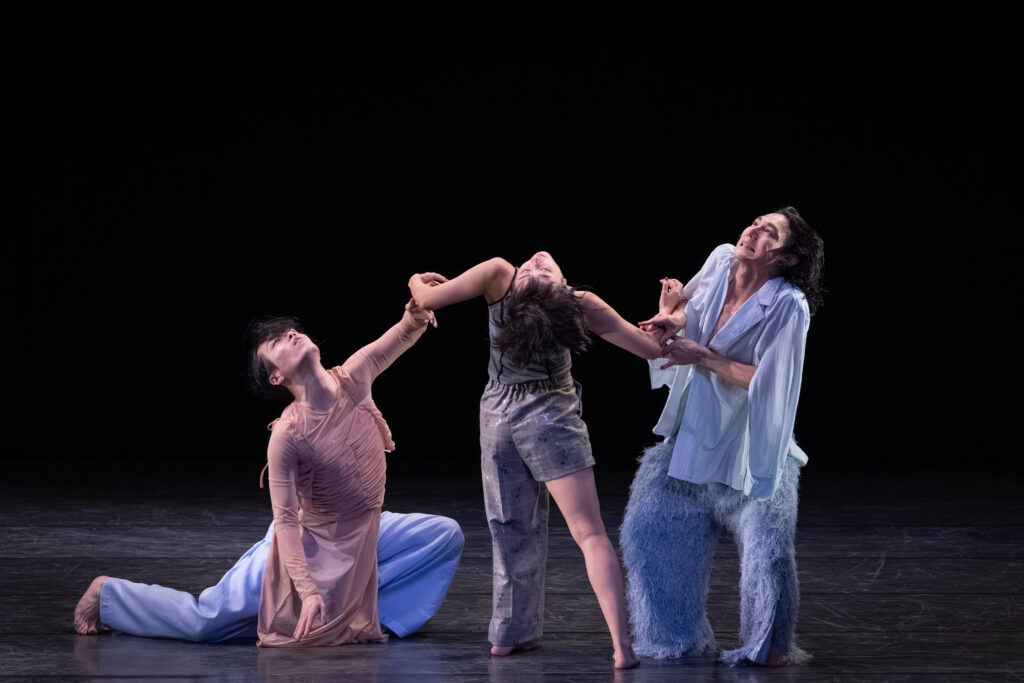
Dance Base Yokohama × Aichi Prefectural Art Theater × Menicon Theater Aoi — Performing Arts Selection 2025 Festival Edition | Teita Iwabuchi, The Great Afternoon: the soft machine xxx — Menicon Theater Aoi / © Naoshi Hatori
Perhaps it could be described as a kind of rapturous beauty. The highlight of Seita Iwabuchi’s new work, The Great Afternoon: the soft machine xxx, is undoubtedly the sequence toward the end.I was utterly captivated by this scene, in which Iwabuchi, Kaho Kogure, and Naoyuki Sakai remained almost motionless on stage, frozen in graceful stillness with ecstatic expressions and elegant poise. However, what truly took my breath away was not the beauty itself.
I just wrote “stillness,” but this is a state entirely distinct from the negation of gesture—such as that stemming from a reaction against the beautiful illusions found in postmodern dance.Rather, it is a state reached at the very end of the complete dissipation of movement; thus, the body remains open, making no attempt to deny that beauty and sensuality might be found there.
That said, it is not a work with a visibly high “kinetic energy.” It begins with a surprisingly slow start, such as the opening sequence in the style of a “living picture,” in which the performers present various poses in a frame-by-frame manner to the melody of Debussy’s “Afternoon of a Faun*.In the next sequence, the performers begin to interact, moving as if in a form of “Aiki,” freely shifting their centers of gravity between each other’s bodies and the space within and around them, presenting a mysterious state that is at times floppy and at times upright.Here, too, the gestures are slow and gentle, but by this point even someone like me can naturally sense that a kind of rich flow of energy is being exchanged between them.Then, as if surrendering themselves to the energy that fills their bodies and the space around them, the three performers fully bring out a wildness that makes them look like beasts—or perhaps infants born into this world for the first time—as they assume various postures and release their voices on the exhale. Here, they are dancing in communion with something invisible.
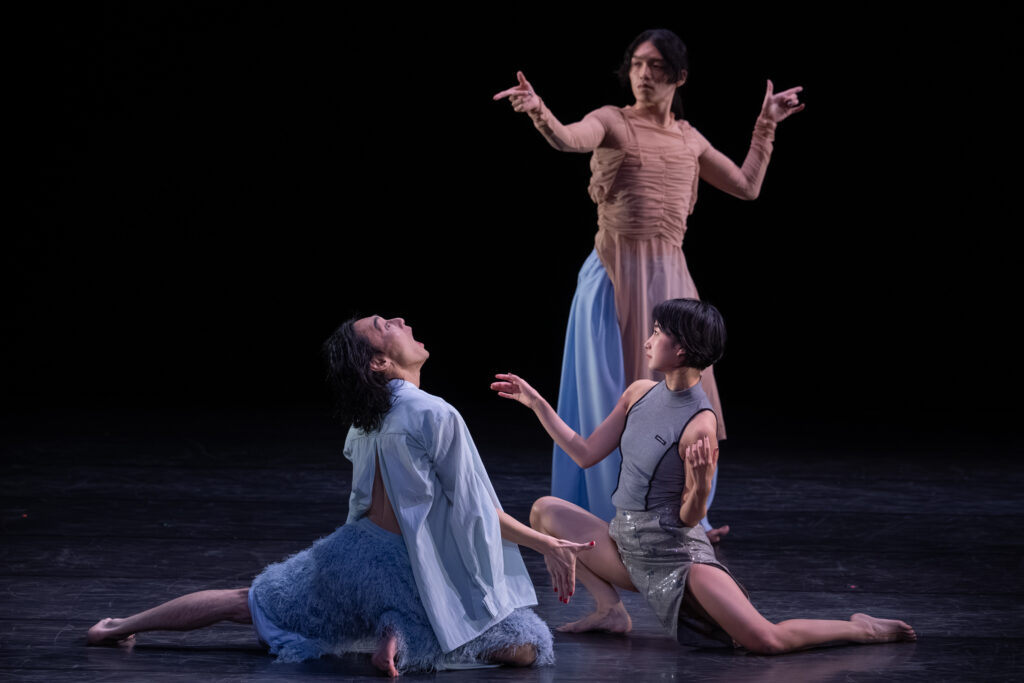 Dance Base Yokohama × Aichi Prefectural Art Theater × Menicon Theater Aoi — Performing Arts Selection 2025 Festival Edition | Teita Iwabuchi, “The Great Afternoon: the soft machine xxx” — Menicon Theater Aoi / © Naoshi Hatori
Now, the title of the work, “The Great Afternoon*, likely refers to Nietzsche’s concept of “The Great Noon”—which he used to describe the time spent on the path toward the Übermensch—while also serving to herald the time that is to come after it.Here, it is worth noting that Yuk Hoi—whom Iwabuchi cited as the ideological foundation for this work—contrasts, in his book “Art and Cosmic Artistry*, the logic of the tragedians, beginning with ancient Greece and epitomized by Nietzsche, with the logic of the Daoists, presenting each as a distinct form of “cosmic artistry”;and if we recall the fact that the form of Dionysian ecstasy seen in this work, as well as Iwabuchi’s proposed “body method”—the theory of the ecstatic body—was indeed established based on the texts of Laozi, then the use of the plural term “cosmic arts,”and development of “cosmic arts” in the plural form, the work emerges as an artistic practice of reflection that seeks to respond to the challenge of what Hui calls the “revolution of episteme”—a challenge that cannot be achieved by the logic of the tragedian alone.Furthermore, as indicated by the subtitle, Iwabuchi referred to the body as a “soft machine” and sought to place its techniques under scrutiny in this work; viewing this technique as a form of cosmic artistry and closely examining its specific, concrete, and local characteristics is undoubtedly an intriguing task in its own right.However, what concerns me is something else.
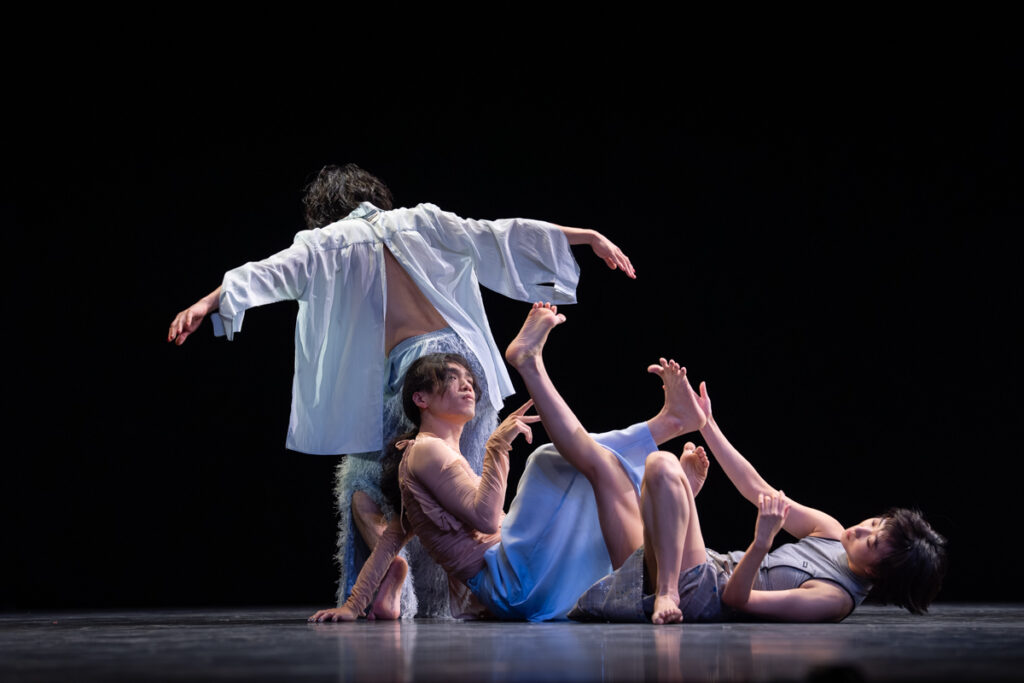 Dance Base Yokohama × Aichi Prefectural Art Theater × Menicon Theater Aoi — Performing Arts Selection 2025 Festival Edition | Teita Iwabuchi, The Great Afternoon: the soft machine xxx — Menicon Theater Aoi / © Naoshi Hatori
To tell the truth, I wasn’t exactly recognizing beauty and reveling in it right in the midst of that ecstatic state toward the end of this work.My repeated use of terms like “beauty” and “graceful” was merely an experiment with my pen; in reality, from my seat in the audience, away from the stage, I was gazing at that body with a clear mind, while paying attention to the “movement” that, though invisible from a distance, must surely have been taking place both inside and outside it.And so, I let my thoughts wander to whatever events the body on stage was perceiving. I believe the three performers’ bodies emitted just enough information to suggest that such movements and events were taking place, andand it seemed perfectly natural to me that there was a body there—one that I could keenly sense—as if it had been reborn into the world with a new body, having passed through a sequence of movements ranging from contact that evoked a state of self-forgetfulness to wild vocalizations and gestures.I don’t really want to stray too far from dance to play with words, but according to Hoi, Nietzsche’s affirmation of the Übermensch—which is sometimes translated as “ecstasy”—is, in essence, “the development of a sensibility that transcends the limits of the five senses”¹—and for Hoi, who reflects on these words, art is likewise directed toward such an expansion of sensation and the cultivation of sensibility. If Iwabuchi’s “soft machine” is to be a cosmic art, then it must be employed as a means to expand cognition and sensibility.
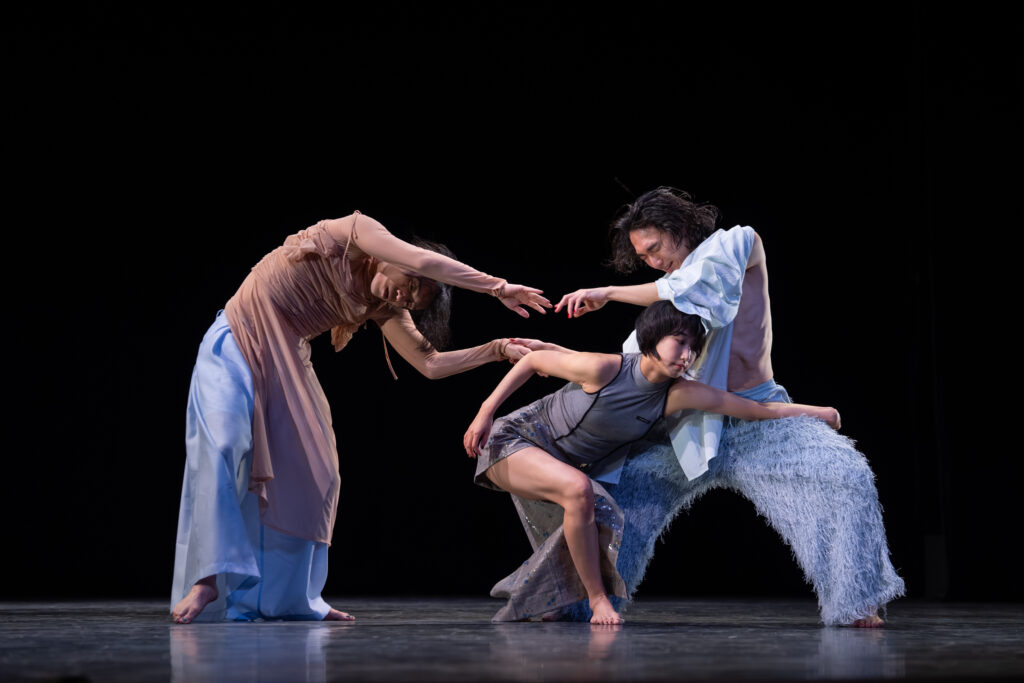 Dance Base Yokohama × Aichi Prefectural Art Theater × Menicon Theater Aoi — Performing Arts Selection 2025 Festival Edition | Teita Iwabuchi, The Great Afternoon: the soft machine xxx— Menicon Theater Aoi / © Naoshi Hatori
However, this kind of sensuous performance presents the common dilemma that the audience cannot directly perceive the expanded senses and awareness that the performers are presumably experiencing on stage.There is a sense of unease—the fear that the very events unfolding on stage, their very essence, may never be shared with the audience—and a certain discomfort that comes from sharing the stage despite this.I know from experience that the success or failure of this kind of adventurous production hinges on the extent to which the playwright sincerely confronts this anxiety, and the extent to which something is still expected of the performance and the audience present.Precisely for that reason, I must admit that I even felt a sense of dissatisfaction that this work possessed such magnificent mise-en-scène—which seemed to have been meticulously crafted in advance—and that, enhanced by elegant music, it gave rise to an aesthetic image so striking that one might even describe it as almost mythical.That said, this may simply be my own concern that this work—which should also be a radical sensorial experiment—might all too easily be perceived as nothing more than a purely aesthetic representation.
1. Yook Hoi (translated by Kohei Ise), “Art and Cosmic Craft*, Shunju-sha, 2024, p. 47.
June 1, 2026
Sakuya Uemura
Mentor: Mari Takeda
◆Profile
Sakuya Uemura
Critic, born December 22, 1998.
Past writings include “Yukio Shiba: A Theory of Theater Production,” “The ‘Theater’ Lies in Your Hands” (published on the “Theater Saikyo-ron-ing” website), and “The Pitfalls of Questions, or the Age of Transparency” (published on the Space Not Blank official website).At PARA, he teaches courses titled “Creating Performances and Building Collectives by Reading Drucker” and “Reading ‘The Dramaturg, Today’” (published in the international journal “Sound Stage Screen*, in English, 2021).Participated in DaBY ProLab’s first cohort, Takao Norikoshi’s “Dance Critic [Training → Deployment] Program,” and was dispatched to Darmstadt, Germany, to cover the Spring Forward festival.
Mari Takeda
Dance critic. In the late 1990s, she was active primarily through the dance criticism magazine “Dance Work*, edited and published by Roku Hasegawa, and the quarterly *Dancerart*. In 2000, she relocated to the Kansai region and has continued to report and write, focusing primarily on contemporary dance.She has contributed to the Osaka edition of the Mainichi Shimbun, “Theater Arts,” the theater criticism magazine “Act,” as well as various online media outlets and the websites of theaters and festivals. In 2019, she served as the facilitator for the “Appreciation & Review Course” organized by the Aichi Prefectural Art Theater, a role she has continued to fulfill intermittently since then. She is a member of the International Association of Theater Critics.
◆“Wings”: International Dance Project by Dance Base Yokohama for Emerging Creators
Dance Base Yokohama (DaBY) has launched a new project titled “Dance Base Yokohama International Dance Project ‘Wings’ for Next-Generation Creators Taking Flight into the World.”
This project is one of the initiatives selected under the [Dance Division] of the Agency for Cultural Affairs’ Fund for Strengthening the Infrastructure of Cultural and Artistic Activities, which supports the development of creators,artists, etc., under the Agency for Cultural Affairs’ Fund for Strengthening the Infrastructure for Cultural and Artistic Activities. It aims to enhance the international presence of Japanese creators by fostering artists, producers, dramaturgs, and critics who represent Japan, staging their works overseas, and creating opportunities for further restagings.
▶︎ Teita Iwabuchi, The Great Afternoon: the soft machine xxx
▶︎ “Wings”: International Dance Project by Dance Base Yokohama for Emerging Creators